
Reconstruct Woodford's Prior Owner Chain
Start with the most recent recorded deed for the parcel. Every row of the chain should carry the transfer date, grantor, grantee, deed type, and book/page citation. Then match the same tract backward in time. You confirm continuity through the legal description. The prior-deed recital also helps, since those details tie each Woodford County instrument to the parcel it conveyed.
| Transfer Point | Grantor to Grantee | Deed Type | Book/Page |
|---|---|---|---|
| Newest deed | Prior owner to current grantee | Read instrument | Current reference |
| Previous deed | Earlier owner to that grantor | Read instrument | Prior recital |
| Split or correction | Parties in special instrument | Correction, plat, estate | Cross-reference |
| Pre-online link | Parties in physical index | Deed-book instrument | Volume and page |
Assessment names alone cannot build the timeline. The Clerk's instrument proves each transfer. GIS and PVA fields point you to the next deed, while plats keep the land identity stable whenever parcel keys change.
Cross Woodford's 1985 Boundary
The Woodford County Clerk states that online documents reach back only to January 1, 1985. Treat that as a web boundary, not the beginning of land history. A later deed's prior book/page citation leads into the Clerk's physical index and deed books, and the KDLA deed guidance explains how to work with those older volumes. The Clerk's public records page documents the modern access range.
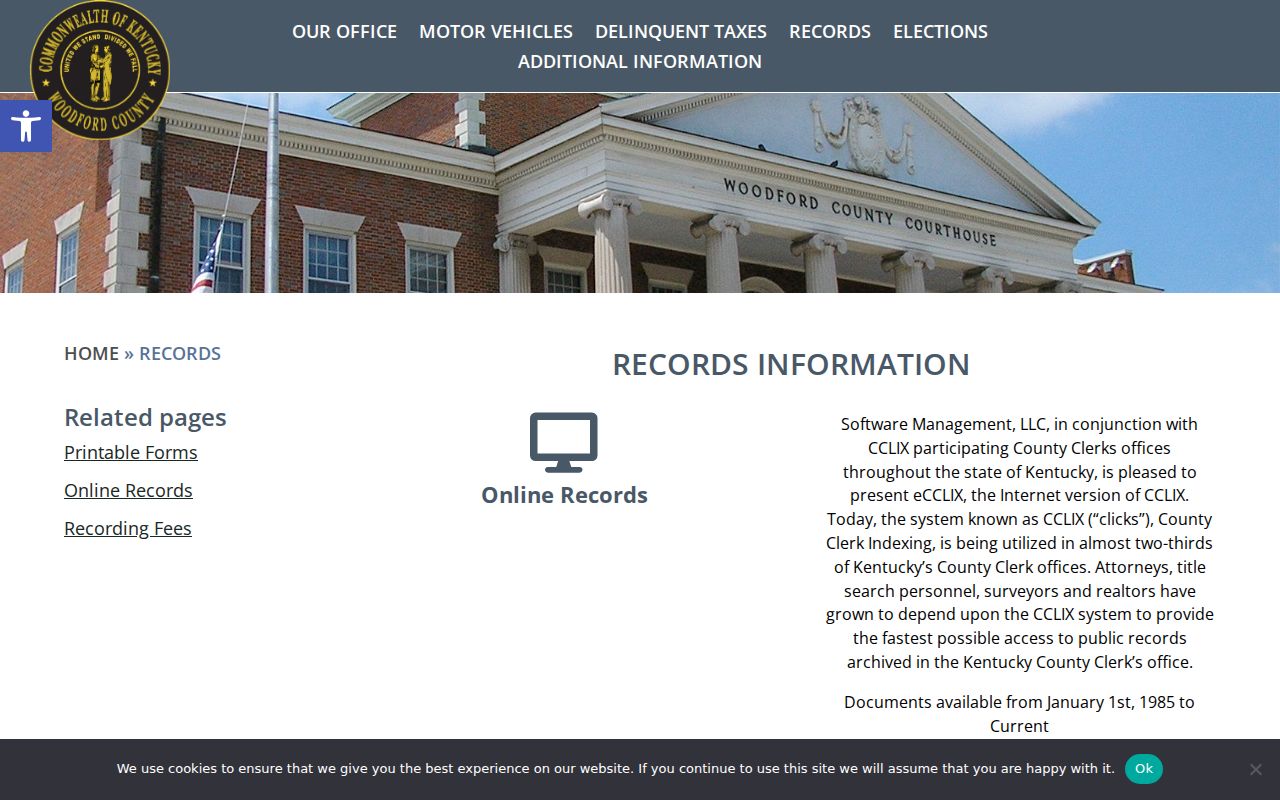
That page confirms the route and the date range it covers. An actual former-owner chain still requires the indexed instrument. It also requires its legal description. No official source publishes the earliest year for every Woodford deed or index series. State only the coverage the office itself verifies.
Coverage boundary. Online documents begin in 1985; earlier prior owners require physical or archival records.
Follow Woodford Tracts, Not Names
The public sample lists TRACT 1 & 2, deed 349-376, and plat C-146. It also includes a seller field. Treat the seller as a lead only. The instrument establishes the true role and the land conveyed. Compare acreage, calls, road frontage, and parent-child parcel references before trusting a match.
A parcel can split, merge, pass through an estate, or enter a trust. Chase spouse, estate, trust, and entity variants only when the deed itself points there.
Build a separate identity sheet for the land. Record the physical address, parcel number, alternate ID, subdivision, lot or tract, acreage, deed reference, and plat reference. Log every wording change as well. Then build the party chain beside it. This keeps a same-name owner with several parcels from landing on the wrong tract. It also shows when an old parcel number retired after a split or consolidation. If the deed cites an easement, restriction, correction, mortgage release, or lis pendens, log that instrument. Do not count its parties as an ownership transfer.
Midway's compact lots often require street and lot variants. Versailles development names may span more than one phase. Always search the instrument role, date, and land description together.
Walk Woodford Deeds Backward
The trick is to walk the deed chain in reverse, working from the most recent transfer back through each earlier owner, then lay the results out in chronological order. Woodford County residents get personal, noncommercial access through eCCLIX with five free searches per day, while commercial users can subscribe.
- Find the newest deed and record its grantee, grantor, description, and prior reference.
- Search that grantor as an earlier grantee, allowing exact name variants.
- Open each candidate and match the tract, not merely the name.
- At 1985, continue through the Clerk's older book and index route.
- Grantor
- The party conveying an interest.
- Grantee
- The party receiving it.
- Chain of title
- The linked series of recorded instruments.
- Reverse index
- An index organized by grantee.
- Quitclaim deed
- A transfer of whatever interest the grantor may have without title warranty.
Extend Woodford Ownership Offline
The Woodford County Library History Room holds local microfilm, newspapers, and special collections. It also offers more than 5,000 vertical files. Onsite Ancestry includes directories, and FamilySearch affiliate images work at the Main and Midway locations. The Main Library History Room sits at 115 North Main Street in Versailles. The Midway Branch offers a second affiliate-access point. A directory can show an address association or an owner/renter mark. It never replaces a deed. Record the directory title and year, page, printed address, and name. Add the spouse notation, owner or renter mark, and abbreviation key. Then compare that clue against the closest deed, probate record, tax list, and census source. Library staff accept a narrow research request by phone, form, or email. They generally describe an effort of about four weeks rather than a guaranteed completion date.
Account for Woodford's Old Borders
Woodford County's official history says the county began in 1792 with far larger boundaries. An old record may name a former jurisdiction, road, or landmark. Preserve those terms exactly as written. The Sheriff's service-since-1789 statement predates the county's own founding date. No official explanation reconciles the two. Keep the discrepancy as stated rather than inventing a timeline.
Use Woodford Plats Across Time
Recorded plats keep one tract in view when previous owners used a different address or when a parent parcel split into several lots. The GIS schema stores subdivision, block, lot, and plat book fields wherever data is populated. Blank fields do not end the search. Acreage land may still be described by tracts, monuments, road frontage, and calls in the deed. Planning maps and notices supply names. They do not settle ownership. Pull the recorded plat, compare dedications and revisions, and return to every deed in the chain.
A consolidation can erase an old parcel key. The historic deeds still stand as valid links. Versailles leads such as Paynes Crossing and Springs of Versailles can carry separate mapped entries, while Midway examples like East Higgins Street involve consolidation. Keep each source role and phase distinct. A correction can repair a name or legal description without marking a market sale. Estate and survivorship records can move an interest too. Probate administration may sit in the Woodford court file while an affidavit of descent, fiduciary deed, will, or later conveyance appears in Clerk records. Record the instrument type beside every former owner, and never fill a missing chain link from a family relationship alone.
Bridge Woodford Estate Transfers
A death can interrupt a simple grantor-to-grantee pattern. Woodford District Court probate files may hold the will, estate appointment, inventory, settlement, and orders. The County Clerk keeps the land records. These offices do different jobs. The Clerk fee schedule treats wills, affidavits of descent, fiduciary deeds, renunciations, disclaimers, and trust documents as distinct record leads. One filing cannot do the work of another.
Start with the decedent's full name and variants, approximate death date, court case number if known, parcel ID, legal description, and current deed reference. Ask the Circuit Court Clerk for the petition, will, fiduciary appointment, inventory, settlement, closing order, and property exhibits. Then search the land records. Look for an affidavit of descent, executor or fiduciary deed, deed of distribution, survivorship instrument, trust deed, disclaimer, renunciation, or correction. Read the legal effect in the document itself.
The PVA adds, removes, or changes a name on the tax record only after an official document such as a deed or will is recorded. That is an update rule. It is not a title opinion. The county publishes no set roll-refresh interval. So a probate event or new deed may predate the assessment-name change. Save three dates: the court filing, the deed recording, and the PVA or GIS retrieval. List an heir, beneficiary, executor, or trustee as a former owner only when the recorded chain shows that interest. Woodford property records reward that caution.
Set Woodford Owner History Limits
No single verified source gives one earliest date for all Woodford ownership records. The sound claim is narrower. Online documents begin in 1985, and earlier links require Clerk or archival work. Stop when the source or land match fails. Former-owner research serves house history, estate work, and boundary diligence. Record only the parties, roles, dates, and land details the chain needs. Label each link as a recorded deed, assessment clue, plat reference, probate filing, directory entry, or newspaper lead. That label keeps a useful clue honest.
Lawful use. Use Woodford prior-owner records for land history, never to track, target, or harass a person.